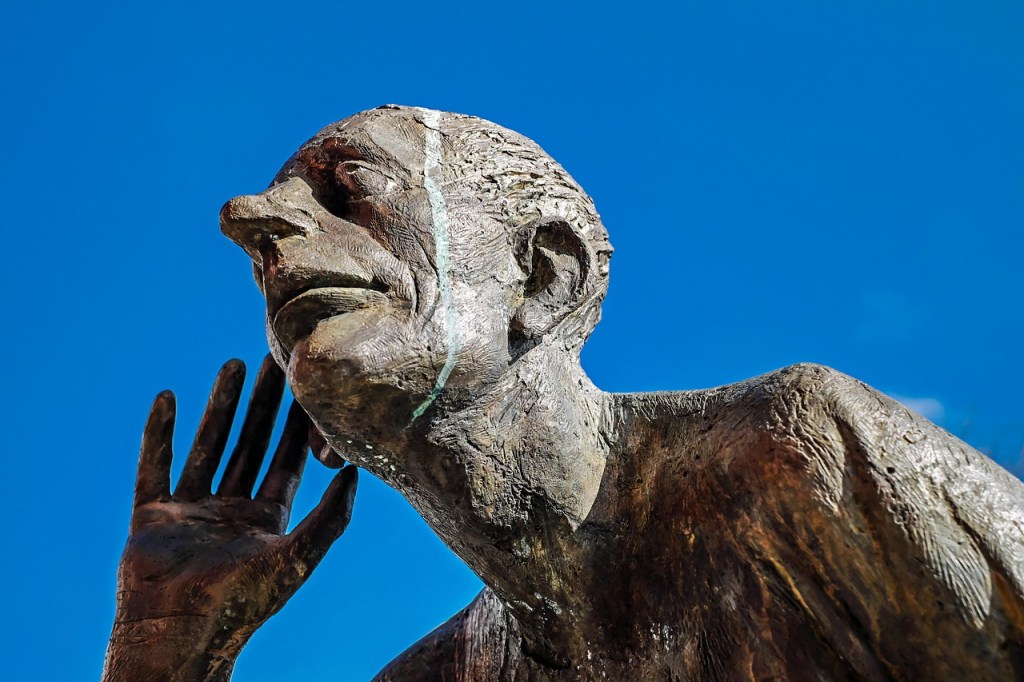
A common question for a journalist is “Who gets a voice in the media?”. The other version of the seemingly same question is “Whose voices get heard in media?” The difference between two phrasings is interesting. The first version leads you to think about whose hand is holding the imaginary microphone at any given time. The other version also leaves room to wonder whether the person is actually being listened to—not just given the chance to say something.
I have ten years of experience working as a journalist, and I’m used to literally giving a voice to all sorts of people—by writing interviewees’ quotes on paper or online, or by holding the mic in front of someone and waiting for their thoughts to be recorded. In the editing room, the journalist then decides which parts of what was said are the most interesting or important, and only those parts end up in the final published story.
On rare occasions, I’ve been interviewed myself on radio or TV, and so I also know what it feels like when a journalist suddenly pulls the microphone away from your mouth, as if to say “we don’t want to hear more.” I once had a colleague who liked to boast that he did the shortest interviews in our newsroom. He said he would write the news scripts in advance and get comments from interviewees to fit the pre-planned spots. “I know exactly what I want the interviewee to say, and that’s all I ask. It only takes three minutes,” he’d sometimes quip.
The question of getting a voice in the media is very concrete and hands-on, and it comes with a lot of journalistic power. The journalist gets to choose whom they will listen to. They choose what parts of the interview will be published. They build the context for what’s being said. They choose the other interviewees. They decide when and how the story gets published. The only power left to the interviewee is to agree or refuse to be interviewed, and to approve their quotes afterwards.
It’s this element of power that makes diversity in journalism—here meaning “who gets a voice in the media”—such a tricky issue. Audiences might find it hard to accept how much power the media holds, while journalists and newsrooms can have trouble shouldering the responsibility carefully enough. Questions of diversity are complex, nuanced, and sensitive to context: there are no ready-made answers. Indeed, how would you answer the question of whose voices the media should promote in public, and whose voices should be minimized? If you know your answer, do you think others would agree with you?
I also know what it feels like when a journalist suddenly pulls the microphone away.
I started researching pluralism and diversity in journalism at Tampere University in 2020. I am doing my doctoral research on what diversity means in journalism in the 2020s, how to measure it, and how to improve it. My research is mostly in Finnish [in which we use the first version of The Question; “who gets the voice in the media”], but the English version “whose voices get heard” has started to interest me more and more. Listening has begun to seem more essential than simply getting a voice.
After all, what’s the point of being given a say if no one listens to or understands you? Is it meaningful nowadays to get a say in public, especially if you might instantly face a flood of negative or hostile comments and social media shares, and aggressive feedback? Publicity, in the atmosphere shaped by social media and its algorithms, has in some places become a toxic space that many people already avoid. Surveys show that it’s getting harder and harder for journalists to get interviews—even from politicians and officials, let alone regular people (see Union of Journalists in Finland 2023; Erho 2025). Fear of hate speech effectively silences people, and even though people in Finland still largely dare to take part in public debate (Reunanen et al 2023, pp. 30), more and more topics are recognized by both the public and journalists as too difficult, or too sensitive, to discuss or write about. The list of sensitive topics keeps growing, and in the latest research on harassment of journalists, the list of story topics causing harassment was already very long, starting with immigration, environmental and energy issues, and ending with the Middle East, Russia, right-wing populism, and health topics. In the same study, a fifth of journalists said that they avoided certain topics or left something out of their stories because they feared pressure or harassment (Hiltunen et al. 2025).
How could listening be a tool for easing these difficulties in public discussion? What happens if journalists listen more carefully to the people they interview?

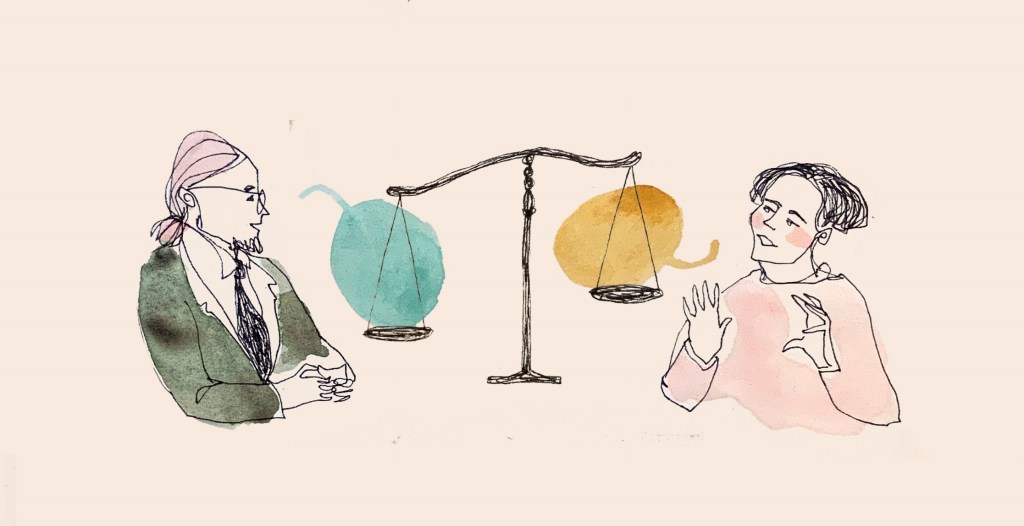
Image is AI generated.
The power of listening is, of course, a well-known phenomenon in communication sciences, and there’s now a new book on the subject in Finnish as well. According to researchers Välikoski and Ala-Kortesmaa, listening is the key to understanding others, growing empathy, and ultimately impacting your surroundings: in other words, listening can achieve a lot. This is partly because being heard and seen is such a central part of basic human needs and our nature (Välikoski and Ala-Kortesmaa 2025).
Literature on dialogical interaction focuses on building shared understanding through interaction. Dialogue is not just any conversation or listening, but has more specific qualitative requirements. In Taneli Heikka’s doctoral research on dialogic journalism, the features of dialogue are identified as collectiveness (“thinking together”), experimentation (“producing concrete results”), non-judgment (“all views are equally valuable”), and self-engagement (“rational thinking as well as emotions and sensations are part of a dialogic process”) (Heikka 2017, p. 26). According to Heikka, dialogue is challenging and rarely succeeds on all these levels.
When dialogic methods are applied in journalistic situations, it raises an important question: when journalists really listen to interviewees, what are they actually listening to? Are people allowed to tell whatever they want? Is there room for criticism and counter-arguments? Is questioning forbidden? How does journalist’s freedom and responsibility to make their own editorial decisions come into play?
I have participated as a journalist in a research project where we discussed these questions with researchers and other journalists. We wanted to understand how journalism could better listen to people when dealing with difficult or conflict-prone topics, without endangering key journalistic principles. We called this approach “conciliatory journalism”. Its three core principles—the foundation for all other work methods—are clarifying tensions, facilitating listening, and maintaining trust.
All three principles revolve around listening. Clarifying tensions means that the journalist investigates, by asking and listening, what the conflict is really about, what is being argued at the deepest level, and how these disagreements have come about. The goal is to gain a thorough understanding of the conflict at hand, which the journalist can then relay to other interviewees and to the story’s audience.
Facilitating listening means that everyone involved feels they have been heard, understood, and taken seriously. This requires careful, empathetic, and active listening (listening vs. hearing). The key is to not just grab onto the first, often provocative statements or opinions, but to use good, disarming follow-up questions that help interviewees feel at ease and open up, to truly understand what she/he means. In this way, it’s possible to listen to “unprintable” or angry speech, too: a skilled listener can discover the underlying reasons, emotions, or stories behind words that might otherwise seem inappropriate or hostile.
The goal is also for participants to “listen to themselves”—to recognize their own possibly biased word choices, the different ways their message can be interpreted, and to take responsibility for the consequences of what they say. Understanding one’s position of power is also part of listening to oneself. Facilitating listening is thus also critical and questioning, not just empathetic. It’s important to remember that understanding someone does not equal approval.
Maintaining trust means that everyone participating in the story can trust the journalist and their fairness, and that agreed rules are followed. The rules here refer to the principles of journalism, which can be clarified on a case-by-case basis: everyone involved should know where and how the story will be published, in what context each person appears, and that interviewees’ views are presented fairly and honestly. The interviewee must be able to trust that the journalist is working to serve the audience, not, for example, to gain clicks or personal prestige. Trust is broader than just the relationship between the journalist and the interviewees: ultimately, it’s about whether audiences and citizens trust journalism’s ability to create fair and relevant public discussion. If this trust falters or is lost, journalism loses its meaning. (See more about conciliatory journalism here.)
Where the magic of listening works best: people’s personal experiences and stories, emotions and needs, as well as their best arguments.
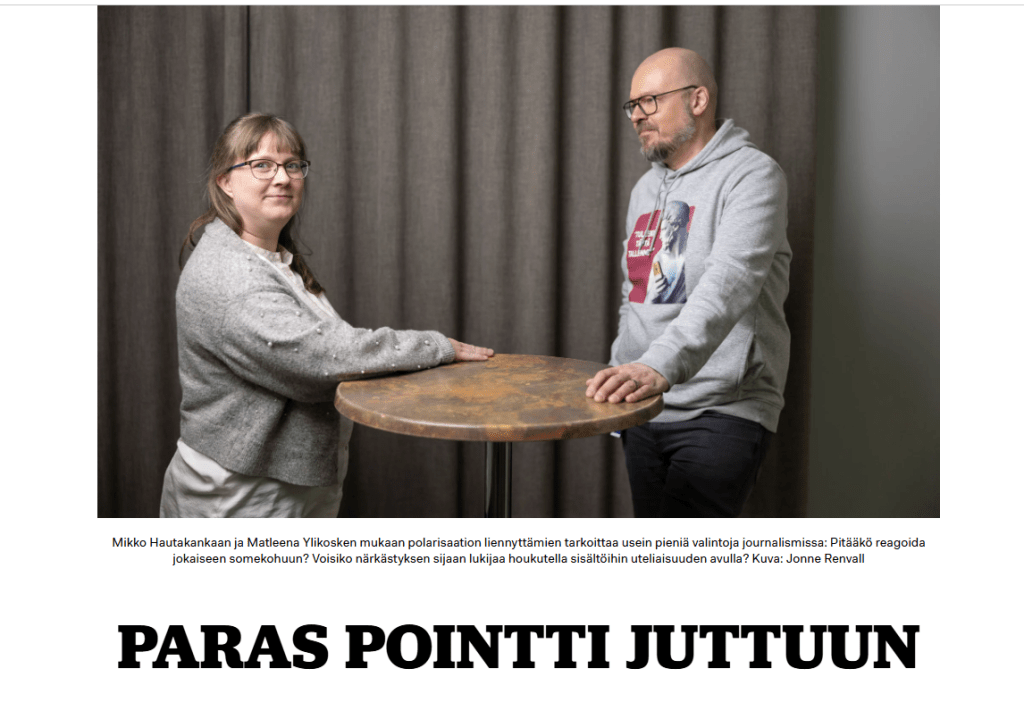
Mikko Hautakangas, media researcher
My colleague, media researcher Mikko Hautakangas, who does his PhD on conciliatory journalism, has said that the “magic of listening” can work in journalism if we understand the differences between dialogue and debate, and focus on creating interaction at the intersection where dialogue and debate meet. The characteristics of dialogue—equality, openness, empathy, sense of peerness, respect for others—and the features of debate—defending one’s own viewpoint, criticizing the opinions of others, and seeking to show where they are mistaken—can thus exist together at a shared intersection. This is a space where journalistic listening is most effective: the focus then is on listening to people’s personal experiences and stories, emotions and needs, as well as their best arguments. A journalist’s professional skill is to identify which of these are relevant to the story at hand, and how to use them in journalistic work that aims to illustrate the universal through the particular, and to make individual experiences socially meaningful.
Reaching the point where someone genuinely feels heard is a significant challenge—whether in everyday life or in journalism. People are complex beings; often we aren’t fully aware even of our own deepest feelings, core beliefs, or habitual ways of thinking, let alone our biases. In any given interview, the real challenge is to discover what, in that moment and on that topic, the person most hopes – or fears – the journalist will hear, understand, and bring to light. I believe that to uncover this, it’s not enough to simply ask questions—you must also listen with real attention and care. The better you listen, the better your story will be.
Literature:
Erho, Nina. Haastattelujen saaminen on vaikeutunut, arvioivat kokeneet journalistit. Miksi asiantuntijat suhtautuvat pyyntöihin nihkeästi? Journalisti 19.3.2025. https://journalisti.fi/artikkelit/2025/03/haastattelujen-saaminen-on-vaikeutunut-arvioivat-kokeneet-journalistit-miksi-asiantuntijat-suhtautuvat-pyyntoihin-nihkeasti/
Heikka, Taneli (2017). Dialogic journalism: How can journalists participate in the networks of social innovation? University of Jyväskylä. https://jyx.jyu.fi/jyx/Record/jyx_123456789_55417
Hiltunen, Ilmari; Reeta Pöyhtäri and Aleksi Suuronen (2025). Journalistien kohtaama painostus, häirintä ja uhkailu Suomessa. Tampereen yliopisto.
Reunanen, Esa (2023). Uutismedia verkossa 2023. Reuters-instituutin Digital News Report Suomen maaraportti. https://trepo.tuni.fi/bitstream/handle/10024/149682/978-952-03-2961-7-6.pdf?sequence=5&isAllowed=y
Union of Journalists in Finland. Journalistien tiedonsaanti vaikeutunut: poliitikot ja viranhaltijat välttelevät haastatteluja. 25.9.2023. https://journalistiliitto.fi/fi/journalistien-tiedonsaanti-vaikeutunut-poliitikot-ja-viranhaltijat-valttelevat-haastatteluja/
Välikoski, Tuula-Riitta ja Sanna Ala-Kortesmaa (2025). Kuuntelemisen voima. Avain ymmärtämiseen, vaikuttamiseen ja empatiaan. Atena. Jyväskylä.
Images: Pixapay and AI

 matleenaylikoski.fi
Jätä kommentti